
There’s eight of them, so which one is the middle one?
We all know that Rome wasn’t built in a day, and a grand piano wasn’t invented overnight. If you think about the size of the keyboard (part of the instruments where the keys are) of a church organ, a harpsichord, or a square piano, you can tell that there must have been some development happening, and that things must have evolved gradually. And indeed, the keyboard of a piano (grand piano or upright piano) now has 88 keys, over seven octaves, but it used to be much smaller.
Various piano’s ancestors, such as the clavichord, harpsichord, or a dulcimer (by the way, I do hope that all these oriental sounding names will prompt you to check them out on Google) were used to play solo, or accompany human voice or other instruments in a home environment (a small room setting), unlike the monstrous grand pianos that we see in today’s concert halls. Their range was much smaller, they were much lighter, and sometimes you could literally close the lid and carry one around like a suitcase.
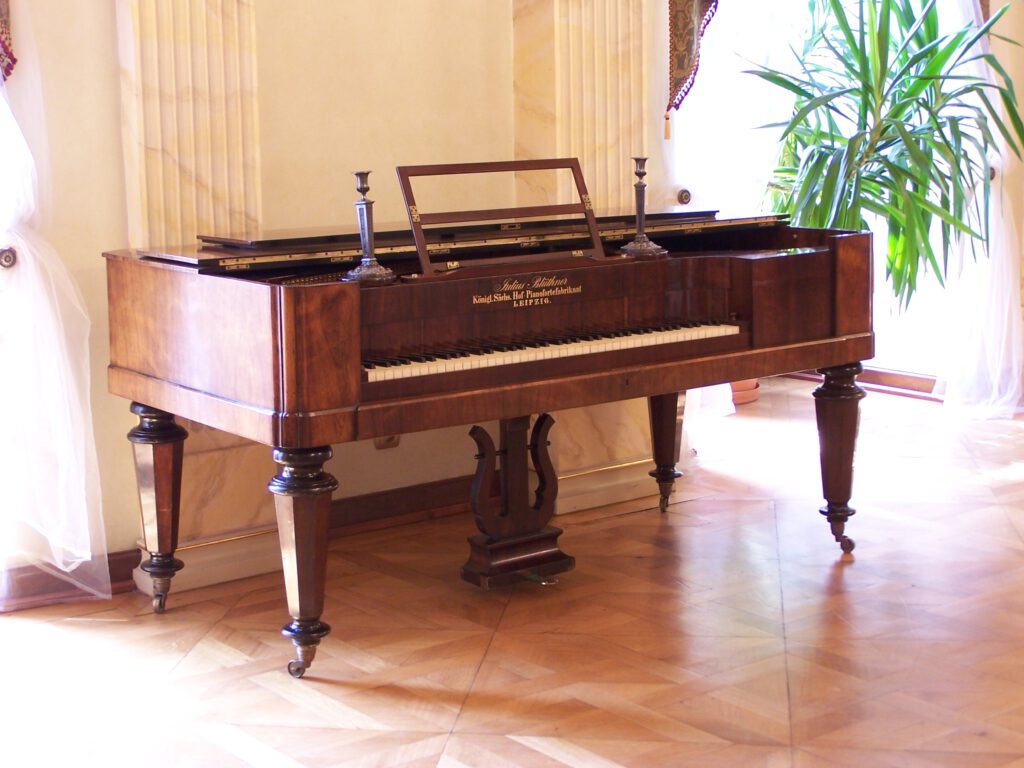
A square grand piano, Historical Museum in Bielsko-Biala, Poland. Credit: Wikimedia Commons. Copyright: Public Domain
How did this change?
This was all before the beginning of the 18th century, when Bartolomeo Cristofori (1655-1731) invented a prototype of a modern piano before 1711 in Italy. Unlike the previous keyboard instruments, his piano could play loudly (forte) or quietly (piano) according to the players wish, hence the name fortepiano (Italian loud-quiet).

Portrait of Bartolomeo Cristofori, inventor of the piano. (The original was lost in the Second World War). Credit: Wikimedia Commons. Copyright: Public Domain
Thanks to that ability (an also to equal temperament tuning system), the popularity of piano as an instrument began gaining momentum in the mid eighteenth-century. It had a relatively loud sound, and the capability of providing space for dynamic ranges and articulation for the performers. From the end of the eighteenth-century, the piano was undergoing rapid modifications and developments expanding from five octaves in the 1790s to almost seven octaves by 1820. The extra keys and the addition of the double escapement action by Érard (lets you play faster repetitions) came in 1821. The cast iron frame (which added a lot of extra weight!) and sostenuto pedal came in 1825 and 1826 respectively. These and other innovations were a response to pianists’ and composers’ preference for broad and powerful sound to fill ever-growing concert halls. This not only increased the appetite for grand pianos but also for uprights as home-music-making instruments both in Europe and America.
So, back to the beginning, which C is the Middle C? Now that the established number of keys is 88 (apart from very rare instances), we can count 8 C’s on the piano. Starting from the lowest C, we number them as follows: C1, C2, C3, C4, ….. C8. And the Middle C is C4.

Grand pianos, upright pianos and digital pianos all have 88 keys, so Middle C will always be C4. But what if we have an electric keyboard? Then the lowest C (C1) is missing, and we start counting from C2. That’s it!
I hope this helped, please get in touch if you have any thoughts or comments, I’m looking forward to hearing from you ?
See you in the next post!